
Don’t Judge A Book By It’s Movie.
On a phone call with a buddy of mine we were talking about books and films, how odd I know. He asked if I had ever read Lost Horizon? I told him I thought I’d seen the Frank Capra film version a long time ago, but couldn’t quite remember for sure.
He told me the book was great and I should check it out. I checked my favorite library and not only did they have the book, they also had the DVD. So I reserved both. Two days later they were ready which also coincided with my weekly visit with my granddaughter.
Every Thursday I pick Luna up from school. She’s in first grade, and we spend an hour or two in the children’s section. They have so many great things there, not just books. We draw and color, we do puppet shows, I just watch. They often have things like scavenger hunts, and finding and identifying various animal stickers that are hidden around the room. We have a great time. Yes, I am a huge library fan and love to see lots of families there encouraging their kids to read.
But I digress.
I grabbed the book and the DVD and headed home.
I rarely ever like both the book and the movie of anything. They are two different mediums and you often have to make major changes to make a film work based on a book. There are exceptions, To Kill A Mockingbird, The Grapes Of Wrath, and in my opinion, very few others.
I know a lot of people will probably disagree with me but I find that whatever I encountered first, either the film or the book, I always prefer the first version. Now, if there’s a book I love, I won’t go see the film. It is almost always a let down.
But...
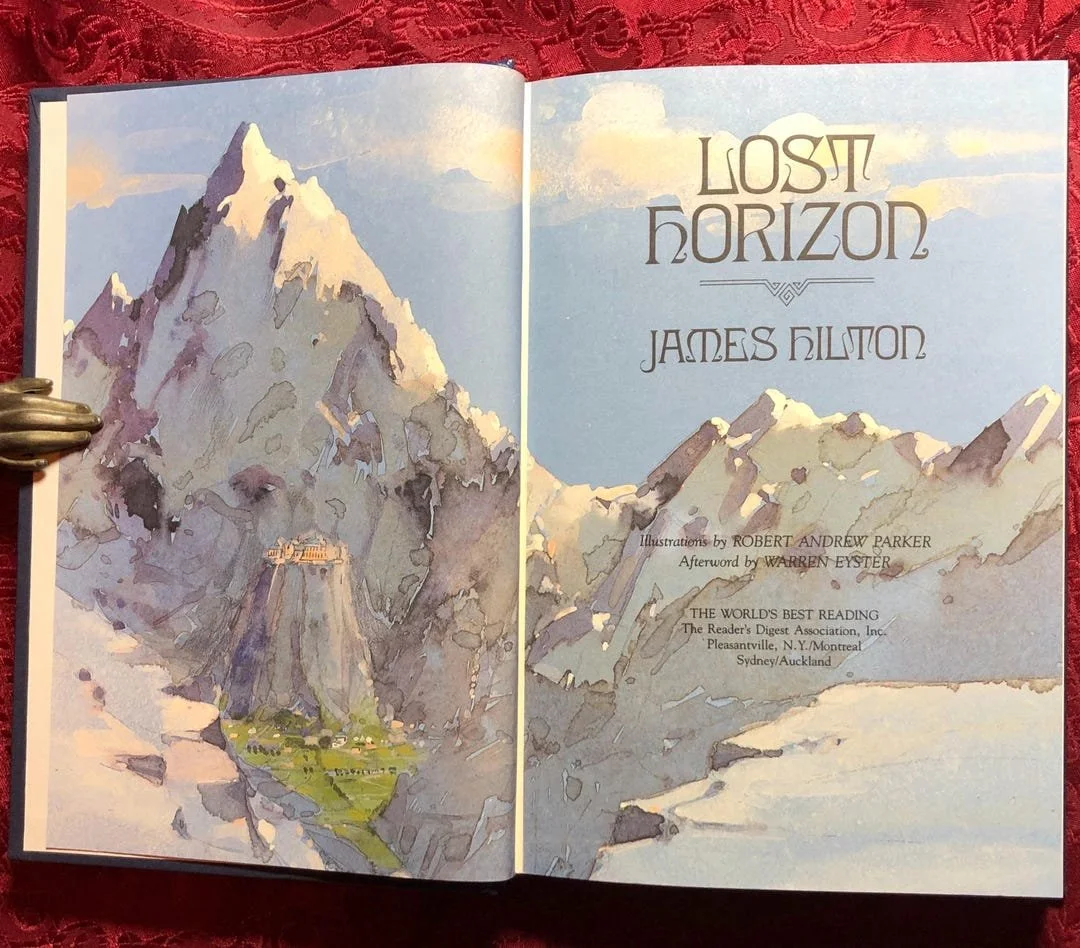
I decided to tackle the book first. Lost Horizon was first published in 1933. I was a little worried when I opened it up and saw it was published by Reader’s Digest. But inside it says, “The Reader’s Digest edition contains the complete text of James Hilton’s, Lost Horizon, first published in 1933.” So it’s not one of their “condensed” books. I don’t know if others remember Reader’s Digest had a whole series of famous books, including the Bible, I kid you not, that they “condensed. So you could tell your friends you had read all of the classics, without having to read all of those pesky words. I remember seeing shelves of those Reader’s Digest Condensed Books and each volume had four or five different books within.
Okay, back to Lost Horizon.
The book is a British novel and starts with three old friends meeting up for dinner and drinks and talk turns to one of their old classmates, Hugh Conway, a British Consul in Afghanistan who disappeared under odd circumstances. Later, two of the men continue talking about Conway, and one man, a writer, reveals that he met up with Conway after his “disappearance” and wrote a manuscript based on what Conway told him before he disappeared again. He gives his friend the manuscript to get his opinion. It felt like the writer considered Conway “mad”, but wondered what his friend would make of Conway’s story. And off we go…
I don’t want to recount the whole plot, suffice it to say Conway is a man who has resigned himself to working for the government and does his job well but without a lot of heart. He is joined by three other people, his young vice-consul, a female British missionary, and a brash American who turns out to be on the run from the police and international authorities for major financial fraud. They end up on a plane that is hijacked by a Tibetan pilot and they eventually crash land in the mountains of Tibet. The pilot dies and they are saved by a group of people from a nearby valley, and a postulant from a nearby monastery called Shangri-La.
It is an isolated place above a beautiful valley. In the book, all of the amazing things the four find at Shangri-La are told rather matter-of-fact. There is no easy way to leave except every few months when porters arrive with supplies from the outside world, like books, art, modern appliances, etc. It’s an amazing place and Conway spends his time in the library reading the classics.
We find out that people actually aren’t allowed to leave, and why would they want to as you have everything you’d ever want and it’s a great life. Conway and soon the American and the Missionary realize they don’t want to leave. It’s the Vice-Consul who keeps pushing to leave.
Of course Shangri-La is a magical place where people age very slowly. The book moves at a reasonable pace and many of the secrets are revealed. Conway is very happy. After many months the Vice-Consul finally arranges for them to leave with the porters. No one wants to leave with him and he eventually pushes on Conway and Conway agrees to go, although his heart is not really into it. He feels a sense of duty to help the Vice Consul.
I’m not revealing anymore of the plot, because I thought it was a good read and it would be great if you picked it up and read it yourself.
One of the things I love is, as the story moves a long, things become more fantastic, even unbelievable. But it all makes sense in the context of the story, so you don’t question it. I love writing like this.
So I popped the DVD in to check it out.
I am a fan of a lot of Frank Capra’s films, although I had a real problem with his Why We Fight series for the U.S. Government, but that’s a different story for a different time.
I knew there was no way they could reproduce this book for the screen, but I had hopes. My hopes were dashed pretty quickly. The film started fine, although they eliminated Conway’s old classmates talking about him and went straight to the action.
Okay, that’s fine. Let’s get this story moving. Right off the bat they make changes to the original characters on the plane. We have Conway, his brother, an American who is still being chased by the International authorities for financial fraud, a Mysterious Woman we never really learn much about although she is beautiful (a Hollywood requirement I suppose), and a meek Paleontologist.
The Brother takes on the role of the Vice-Consul in the book as the one who wants to leave more than anything. The Paleontologist is right there with him but eventually doesn’t want to leave either. I’m not even sure why he’s in the film? The American and the Mysterious Woman aren’t in the film a whole lot and don’t have a lot to do.
We also get two love interests. One for Conway and one for his Brother. His Brother’s love interest is similar to a woman in the original book. In the original book, she is a catalyst to move the plot forward. She plays a smaller role in the film and is a much weaker character. Oh well...
The way the story works in the film didn’t work for me at all. As a writer and a filmmaker I knew there were so many things they would need to lose for the film, and I get it. In the book there were multiple conversations between Conway and others, including the High Llama. Conway slowly realizes what’s really going on through these conversations.
In the film everything is condensed, and the realizations come way too quickly. They lose some of the mystery and some of the “wow factor” you get from reading the book. There’s not a lot of breathing room, especially because they have crammed in these love interests.
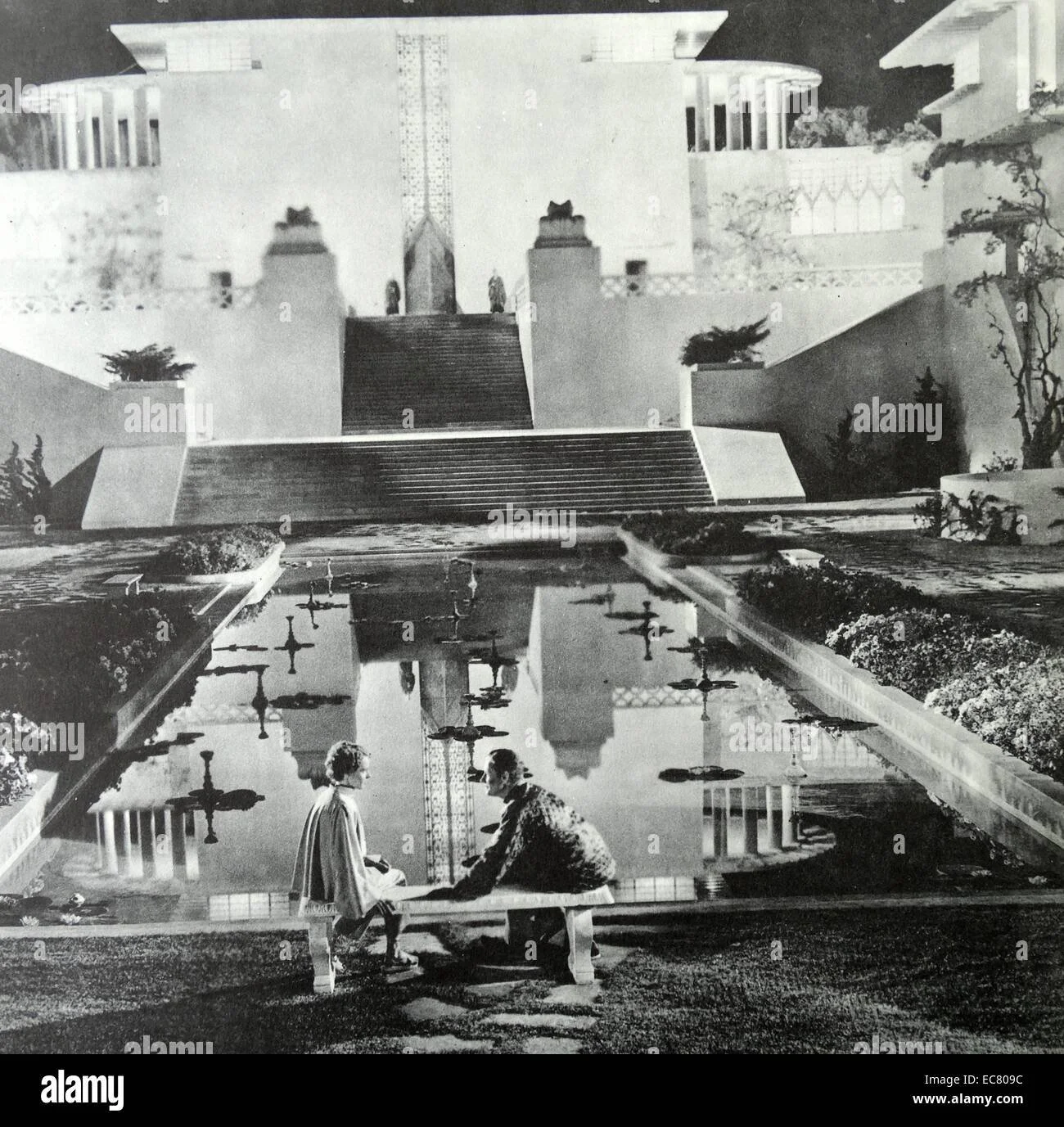
On the plus side it was really cool to see a Hollywood studio film from the late 1930’s with all of the amazing locations and scenery that were really studio sets. Obviously this is long before digital effects and computers so everything was built by hand, either full sized or as miniatures. I believe the optical printer is used to create some of the effects as it was a fairly new tool. But a lot of this was in camera effects and for you students of cinema I thought it was cool to see those again. Modern audiences will think the effects are crude.
Overall the film disappointed me because of the changes they made to the story, stripping it of it’s complexities and favoring spectacle. “Favoring spectacle” – what a surprise, right?
I probably would have felt differently if I hadn’t read the book.
A musical version of the book called Shangri-La was an unsuccessful play on Broadway. The film was also remade as a musical in 1973. I cannot imagine this book as a musical, on either stage or screen.
I’m glad I read the book and saw the film, and I recommend both for different reasons. In the book the story is laid out wonderfully. Well worth reading. The film is great as a reminder of some of the big Hollywood Studio films of the era. A fun watch if you’re not comparing the two.
As usual, Thank You for reading, subscribing, and supporting my writing and filmmaking.
Remember, if you don’t like what I’m writing these days then unsubscribe. And don’t let the door hit you on the way out.
A1 Trophy Company
I’m sure most of you had no idea that I did a reading from one of my books in Santa Monica, California in 1965. Opening the T.A.M.I. show, I shared the stage with the Rolling Stones, The Supremes, James Brown, Chuck Berry, and so many more. I was introduced by Jan & Dean. The downside was I was cut from the final film. (The same thing happened to me years later at Woodstock.) Here is that rare footage of me reading a segment from my story about the time I worked running a drill press at a trophy factory. Enjoy!
If you like the story please head over to my website (www.angryfilmmaker.com) and pick up a copy of the book. I would appreciate it.
Don’t let the bastards get to you!
Please Support Independent Artists! Even the crazy ones.
Check out my books, as well as my films, and Angry Filmmaker merchandise on my site. www.angryfilmmaker.com