
The Best Years Of Our Lives
A couple of weeks ago I ran across this film on Kanopy. I remembered seeing it when I was in film school and loving it so I decided to watch it again forty years later. It is still an incredible film.
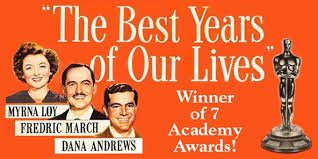
The Best Years Of Our Lives, is a 1946 American drama film directed by William Wyler. The film is credited for its portrayal of the hardships of the post-war era and reincorporation of men into society after their traumatic terms in the US Military. It stars Frederic March, Myrna Loy, Dana Andrews, Teresa Wright, Virginia Mayo, and an amazing performance by Harold Russell.
The film is about three servicemen readjusting to societal changes and civilian life after returning from World War Two. They come from from different social class backgrounds and from different branches of the service with different ranks. This is one of the first films that deals with issues encountered by returning veterans in the post World War Two era, such as PTSD, and returning to normal civilian life.
Frederic March is older than the others. He worked in a bank before joining the army and has achieved the rank of Sergeant. Dana Andrews worked behind the soda fountain in a drug store before becoming a bombardier and achieving the rank of Captain. Harold Russell plays Homer, a Navy man who lost both of his hands during the war.
Side note, Harold Russell was not an actor, but a real Navy veteran who actually lost his hands in the war. He also won an Academy Award for his acting in this film.
https://www.youtube.com/watch?v=cLDBiSPKgKI
The acting and story telling in this film is first rate. William Wyler was also in the war and actually lost part of his hearing while making a documentary, The Memphis Belle: A Story if a Flying Fortress (1944). He flew on the bomber over enemy territory on actual bombing missions.
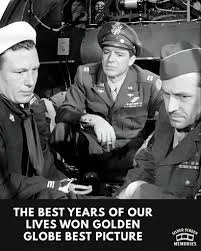
After what they have been though, none of the men are ready to go back to regular civilian life. They all have problems they must navigate as well as getting to know their families once again after being gone for so long. It seems like those around them want them to just forget about the war and go back to who they were and what they were doing before. Not an easy thing for them to do.
One of the reasons this film hit home for me was, I remember having conversations with my Father about what he did after he came back from World War Two. He and his friends did a lot of drinking and he worked a series of jobs that he had no interest in. He was being told, “forget what you saw, go back home and be a productive member of society.” He told me that he spent a couple years just drifting around until he finally decided to get his high school diploma so he could use the GI Bill to go to college.
It feels to me that our country is very good at sending people off to fight, but not at helping our veterans to deal with the trauma of battle. I think this is true throughout our history. Once again we have another administration looking to start wars with other countries while they continue to cut services from the VA.
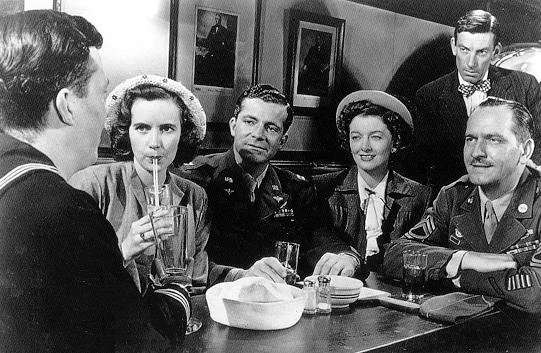
The fact that this film was made right after the war, in 1946, and deals with these very real issues that have not gone away is amazing.
There is no fighting in this film, no battle scenes, no real physical violence. Just three different people and their families trying to survive after the war. The film is long, 2 hour, 50 minute, and yes there is some “melodrama” and a few things that a modern audience might see as “corny”, but at it’s core this film is very real.
I love the title, The Best Years Of Our Lives. What years were the best of their lives? Were they before the war? During the war? Or are the best years still to come? The film leaves that up to you.
Another film that I show to my class every January is John Huston’s documentary, Let There Be Light. It was also shot right after the war at the Long Beach Hospital. It follows a group of soldiers who have returned from the war and are all dealing with various mental health issues. It’s not an easy film to watch. This film was made in 1946, and the government banned it until the mid 1970’s. Why? Because returning soldiers are not supposed to have mental health issues. The government did not want the American people to see this film, they were afraid people wouldn’t support wars if they saw it.
Yes, many soldiers came back and did integrate back into normal civilian life, but not all of them. And we certainly don’t do enough to take care of the ones that need our help.
Please check out these films if you can. I think they’re important, and just once I would love to see us put more money into the care of returning veterans, hell, we need to spend more money on taking care of all people, then we do on fighting wars and building weapons.
You can find The Best Years Of Our Lives here - https://www.youtube.com/watch?v=mAfM_1RirWY
And Let There Be Light is available at https://www.youtube.com/watch?v=uiD6bnqpJDE
Thank you all for reading, subscribing, and supporting me and my writing.
Don’t let the bastards get to you!

And yes my books are for sale, or you can stream my films. Here is my short film, Stolen Toyota for your viewing pleasure. - https://www.youtube.com/watch?v=0SOJknaK8dI
Please Support Independent Artists! Even the crazy ones.
If you want to check out any of my books, as well as my films, or Angry Filmmaker merchandise head on over to my website. www.angryfilmmaker.com
Follow me on Substack - https://substack.com/@kelleybakerangryfilmmaker
Instagram - https://www.instagram.com/angryfilmmaker/
Facebook - https://www.facebook.com/kelley.baker